

Malagoli C, Malavolti M, Agnoli C, Crespi CM, Fiorentini C, Farnetani F, Longo C, Ricci C, Albertini G, Lanzoni A, Veneziano L, Virgili A, Pagliarello C, Santini M, Fanti PA, Dika E, Sieri S, Krogh V, Pellacani G, Vinceti M.
J Nutr. 2015 Aug;145(8):18…
Oral communication: Dietary cadmium intake and breast cancer risk: a meta-analysis of longitudinal studies and results of the ORDET cohort study
Marco Vinceti, Sabina Sieri, Tommaso Filippini, Vittorio Krogh
Oral presentation at II° Cadmium Symposium 2015. Sassari – June 25-27, 2015
Cadmium is a heavy metal with estrogenic activity and established human carcinogenicity, but uncertainties exist about the amounts of exposure and the cancer types involved. In particular, the possibility that dietary cadmium may increase breast cancer risk was suggested by one cohort study, but results of the other four longitudinal investigations were inconsistent. We meta-analyzed these studies using a random-effects model, and we computed the summary relative risk (RR) of breast cancer along with its 95% confidence interval (CI) in subjects with the highest versus the lowest cadmium intake category. Summary RR was 1.00 (95% CI 0.87-1.15), while limiting the analysis to estrogen-receptor positive breast cancer RR was 1.05 (0.94-1.16). We also investigated the relation between cadmium intake and breast cancer risk in the ORDET cohort, a prospective study of 9,343 healthy women of Varese province, Northern Italy, recruited between 1987 and 1992 and followed for cancer occurrence until December 2009. Dietary habits and the corresponding estimated cadmium intake were assessed at baseline via a food frequency questionnaire. During 158,190 person-years of follow-up, 419 breast cancer cases occurred. In a multivariate Cox regression model adjusting for several potential confounders, the hazard ratio (HR) of breast cancer increased with increasing quintiles of cadmium intake, with values of 1.19, 1.23, 1.36 and 1.66, respectively (P trend=0.019) compared with bottom category. HR associated with 1-unit increase of Cd intake was 1.12 (1.03-1.21). After stratifying the analysis according to estrogen-receptor, human epidermal growth factor-receptor 2 and progesterone-receptor status, the receptor-positive breast cancer subtypes showed the strongest association with cadmium intake. Overall, these results suggest that dietary cadmium increases breast cancer risk, particularly for some disease subtypes, though the possibility of unmeasured confounding must also be considered.
Poster: Assessment of cadmium levels in serum, toenails and diet: A cross sectional study in Modena, Northern Italy
Background and Aims
Cadmium (Cd) is a heavy metal that poses serious environmental health hazards to humans. Cigarette smoking and some occupations are major sources of exposure, while for non-smokers and subjects unexposed in the workplace, ingestion…
Poster: Correlation between cadmium and selenium blood levels in an Italian population
Background and Aims
Cadmium (Cd) is established as a human carcinogens while selenium (Se) is a metalloid showing an intriguing relation with human health, particularly with cancer. Se is usually present both in the environment and in living organisms…
Poster: Sources of cadmium exposure in an Italian population: A cross-sectional study
Background and Aims
Main sources of Cadmium (Cd) exposure in the human are food and cigarette smoking as, but also outdoor and indoor air pollution can be important, mainly from industrial emissions, fossil fuel combustion and solid waste incineration…
Poster: Cadmium dietary intake in a Northern Italy population
 Background and Aims
Cadmium (Cd) is an ubiquitous toxic heavy metal. The International Agency for Research on Cancer (IARC) has classified Cd as a human carcinogen (Group I) mainly on the basis of occupational studies. Recent epidemiological studies have shown a direct association between Cd exposure and risk of cancer at several sites (lung, endometrium, bladder and breast) also in the general population. Main source of exposure to Cd, except for smokers and for occupationally-exposed individuals, is food. The highest concentrations of Cd are generally found in products such as seaweed, fish and seafood, chocolate, mushrooms, oilseeds and edible offal, while food groups that mainly contribute to dietary exposure to Cd, as a result of high consumption, are cereals and cereal products, vegetables, nuts, potatoes and meat products. The average Cd intake from food generally varies between 8 and 25 µg/day (more than 80% from cereals and vegetables). Limited evidence about current main sources of Cd intake in the Italian population, however, is available.
Original article: Selenium speciation in human serum and its implications for epidemiologic research: A cross-sectional study
Vinceti M, Grill P, Malagoli C, Filippini T, Storani S, Malavolti M, Michalke B.
J Trace Elem Med Biol. 2015;31:1-10.
Abstract
Observational studies addressing the relation between selenium and human health, particularly cancer r…
Original article: A Review and Meta-Analysis of Outdoor Air Pollution and Risk of Childhood Leukemia
Filippini T, Heck JE, Malagoli C, Del Giovane C, Vinceti M.
J Environ Sci Health C Environ Carcinog Ecotoxicol Rev 2015;33:33-66.
Abstract
Leukemia is the most frequent malignant disease affecting children. To date, the etiology of childhood leukemia remains largely unknown. Few risk factors (genetic susceptibility, infections, ionizing radiation, etc.) have been clearly identified, but they appear to explain only a small proportion of cases. Considerably more uncertain is the role of other environmental risk factors, such as indoor and outdoor air pollution. We sought to summarize and quantify the association between traffic-related air pollution and risk of childhood leukemia, and further examined results according to method of exposure assessment, study quality, leukemia subtype, time period, and continent where studies took place. After a literature search yielded 6 ecologic and 20 case-control studies, we scored the studies based on the Newcastle-Ottawa Scale. The studies assessed residential exposure to pollutants from motorized traffic by computing traffic density in the neighboring roads or vicinity to petrol stations, or by using measured or modeled nitrogen dioxide and benzene outdoor air levels. Because heterogeneity across studies was observed, random-effects summary odds ratios (OR) and 95% confidence intervals (CI) were reported. Whenever possible we additionally conducted stratified analyses comparing acute lymphoblastic leukemia (ALL) and acute myeloid leukemia (AML). Limiting the analysis to high-quality studies (Newcastle-Ottawa Scale ≥ 7), those using traffic density as the exposure assessment metric showed an increase in childhood leukemia risk in the highest exposure category (OR = 1.07, 95% CI 0.93–1.24). However, we observed evidence of publication bias. Results for NO2 exposure and benzene showed an OR of 1.21 (95% CI 0.97–1.52) and 1.64 (95% CI 0.91–2.95) respectively. When stratifying by leukemia type, the results based upon NO2 were 1.21 (95% CI 1.04–1.41) for ALL and 1.06 (95% CI 0.51–2.21) for AML; based upon benzene were 1.09 (95% CI 0.67–1.77) for ALL and 2.28 (95% CI 1.09–4.75) for AML. Estimates were generally higher for exposures in the postnatal period compared to the prenatal period, and for European studies compared to North American studies. Overall, our results support a link between ambient exposure to traffic pollution and childhood leukemia risk, particularly due to benzene.
Poster: Residence near electrical tranformer rooms and risk of childhood leukemia – An Italian population-based case-control study
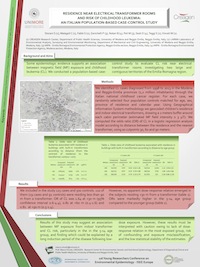 Background and Aims:
Some epidemiologic evidence supports an association between magnetic field (MF) exposure and childhood leukemia (CL). We conducted a population-based case-control study to evaluate CL risk near electrical transformer rooms investigating two large and contiguous territories of the Emilia-Romagna region.
Methods:
We identified CL cases diagnosed from 1998 to 2013 in the Modena and Reggio-Emilia provinces (1,2 million inhabitants) through the Italian national childhood cancer register. For each case, we randomly selected four population controls matched for age, sex, province of residence and calendar year. Using Geographical Information System methodology we geocoded children’s residence and indoor electrical transformers, drawing a 2 meters buffer around each cabin perimeter (estimated MF field intensity ≥ 3 µT). We computed the odds ratio (OR) of CL in a logistic regression analysis model according to distance between the residence and the nearest transformer, using as cutpoints 30, 60 and 90 meters.
Poster: Traffic-related air pollution and risk of childhood leukemia: a meta-analysis
Background and Aims:
Childhood leukemia is overall a rare occurrence, however it is the most frequent malignancy affecting children under 15 years of age. The majority of these cases are acute lymphoblastic leukemia (ALL), followed by acute myelo…